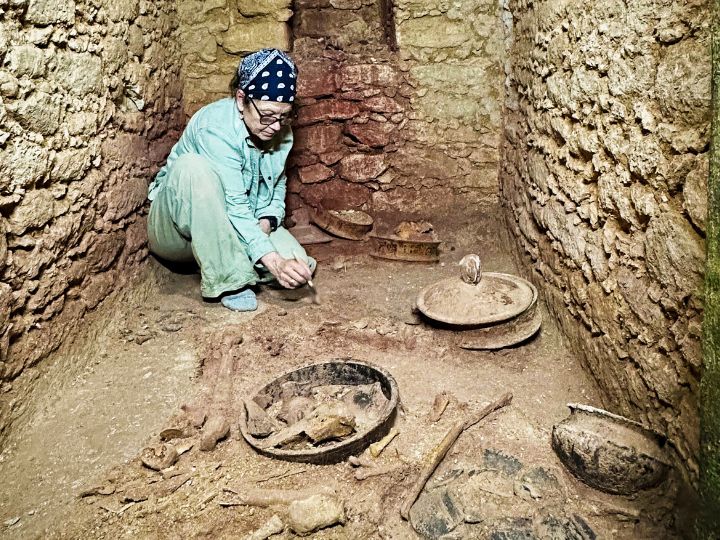
By Belize Live News Staff: University of Houston-led dig teams have discovered the tomb of Te K’ab Chaak, the first ruler of Caracol. This is the first identifiable royal tomb found at the site in over 40 years of active research.

Te K’ab Chaak, believed to have taken power in 331 AD, is buried under a shrine in Caracol’s Northeast Acropolis. His tomb included an impressive cache: eleven pottery vessels, jadeite jewelry, bone tubes, a mosaic jadeite mask, and Pacific spondylus shells. Several pots depict significant imagery—one shows a ruler with a spear being honored with offerings, while another portrays Ek Chuah, the Maya god of trade. Coatimundi head–shaped pottery lids signified the ruler’s legacy; the animal—tz’uutz’ in Mayan—featured later in royal names.
Archaeologists Diane and Arlen Chase estimate Te K’ab Chaak stood about 5′7″ tall, was elderly, and had no teeth at death. His burial dates back to about 350 AD, aligning with two other burials in the same zone, including a cremation in 2010 that contained central Mexican artifacts: obsidian blades, atlatl points, knives, and a projectile tip.
“This suggests early Maya elites”— the Chases say—“were deeply connected with central Mexico and influenced by Teotihuacano rituals well before the so-called Entrada of AD 378.”
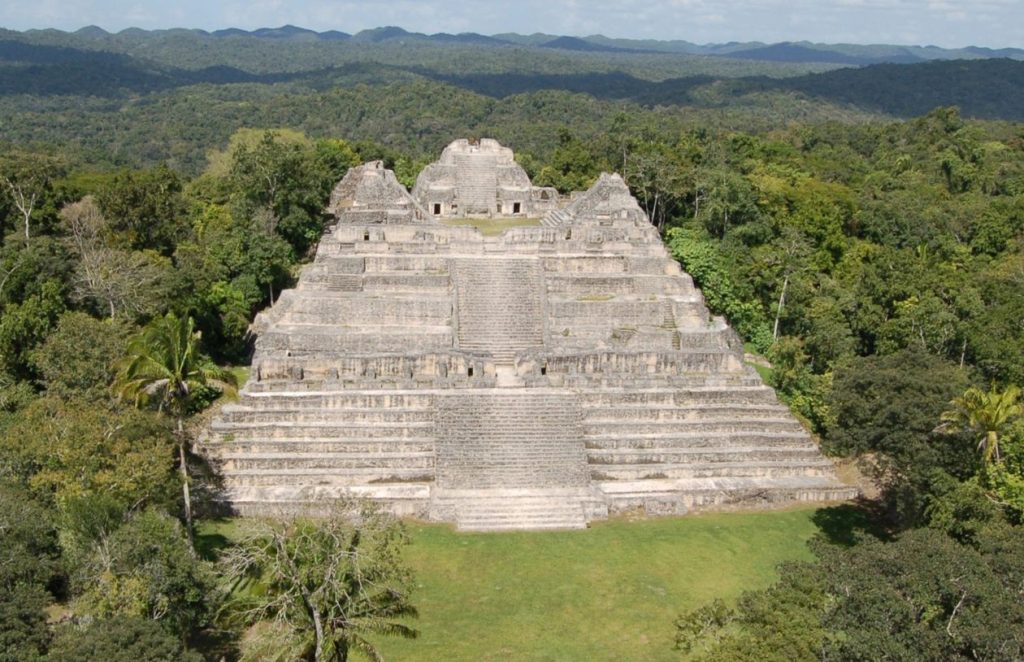
A further tomb—of a woman—was also discovered in 2009 in the same precinct. Together, the burials show Caracol’s royal dynasty engaged in multi-generational foreign relations.
Arlen Chase emphasizes: “These were not casual traders but elite emissaries with formal diplomatic ties.”
Caracol’s Dynasty reigned for over 460 years, asserting dominance in the southern Yucatán region. Previous LiDAR mapping and inscriptions uncovered its defeat of Tikal in AD 562, establishing its political primacy.
Current research focuses on reconstructing the jadeite mask and conducting DNA/isotope work on the skeletal remains. Full findings will be presented at a Santa Fe Institute–hosted conference on Maya–Teotihuacan relations this August.
Belize Live will follow up with field reports and interviews as more details emerge from ongoing analysis.