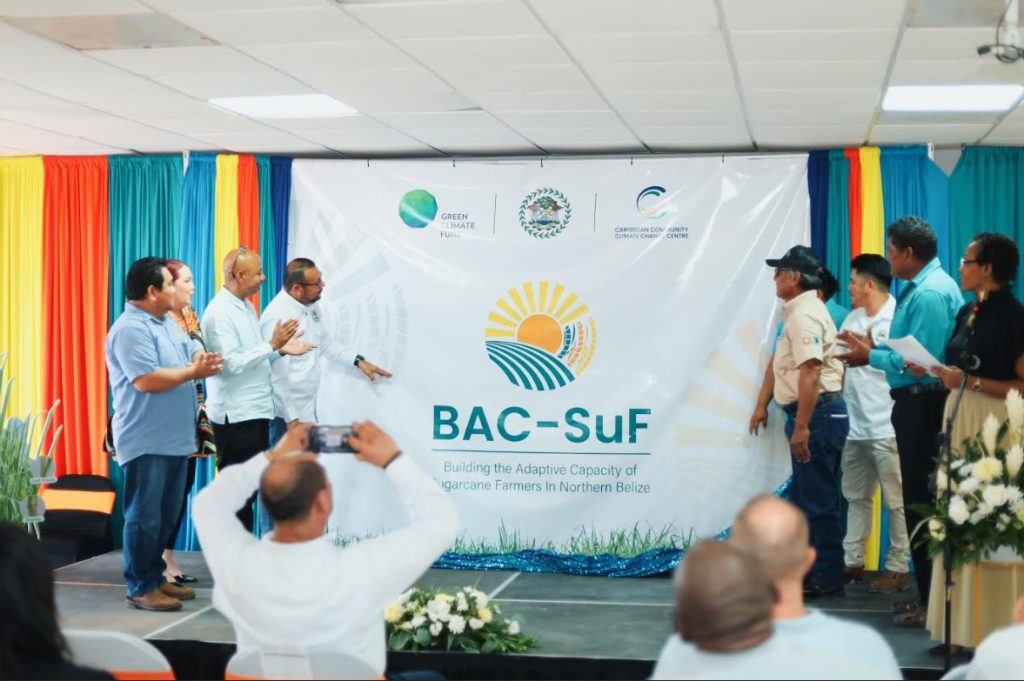
By Belize Live News Staff: The Caribbean Community Climate Change Centre (CCCCC), in collaboration with the Government of Belize, has officially launched the Building the Adaptive Capacity of Sugarcane Farmers in Northern Belize (BAC-SuF) Project. This historic initiative, which aims to strengthen the resilience of the sugarcane industry against climate change, was unveiled at the Escuela Secundaria Técnica México in Corozal.

With a total investment of BZD $77 million (USD $38.8 million), the project is supported by a BZD $50 million (USD $25 million) grant from the Green Climate Fund (GCF), along with BZD $27.7 million (USD $13.8 million) in counterpart resources. The project highlights Belize’s commitment to climate adaptation and seeks to protect thousands of livelihoods in the sugarcane industry.
Minister of Agriculture Jose Abelardo Mai emphasized the urgency of implementing climate-smart strategies, citing the 2019-2020 drought, which led to a 20% decrease in rainfall and a 20% drop in sugarcane production, causing financial distress for farmers. He stressed that proactive investment in climate adaptation is crucial to securing the industry’s future.
Dr. Colin Young, Executive Director of the CCCCC, described the project as the first-ever GCF-funded initiative focused exclusively on sugarcane resilience. He highlighted the initiative’s aim to overcome agronomic, technological, and institutional challenges by equipping farmers with the necessary tools and knowledge to withstand climate uncertainties.
The BAC-SuF project is structured around three core components. The first involves climate-adapted sugarcane farming, which includes the establishment of nurseries for resilient sugarcane varieties, replanting 10,000 acres, and improving soil and ratoon management. The second focuses on sustainable water and land management, with investments in drainage, irrigation, and pest control systems to support climate-smart agricultural practices. The third component is centered on knowledge development and farmer training, creating a hub for information sharing to help farmers adapt to changing climate conditions.
More than 5,000 sugarcane farmers in northern Belize are expected to directly benefit from the project, while approximately 87,000 individuals, including their families and local communities, will experience indirect positive impacts. Minister Mai reaffirmed the government’s dedication to assisting farmers in transitioning to sustainable practices, ensuring the long-term growth and stability of the sugarcane industry.