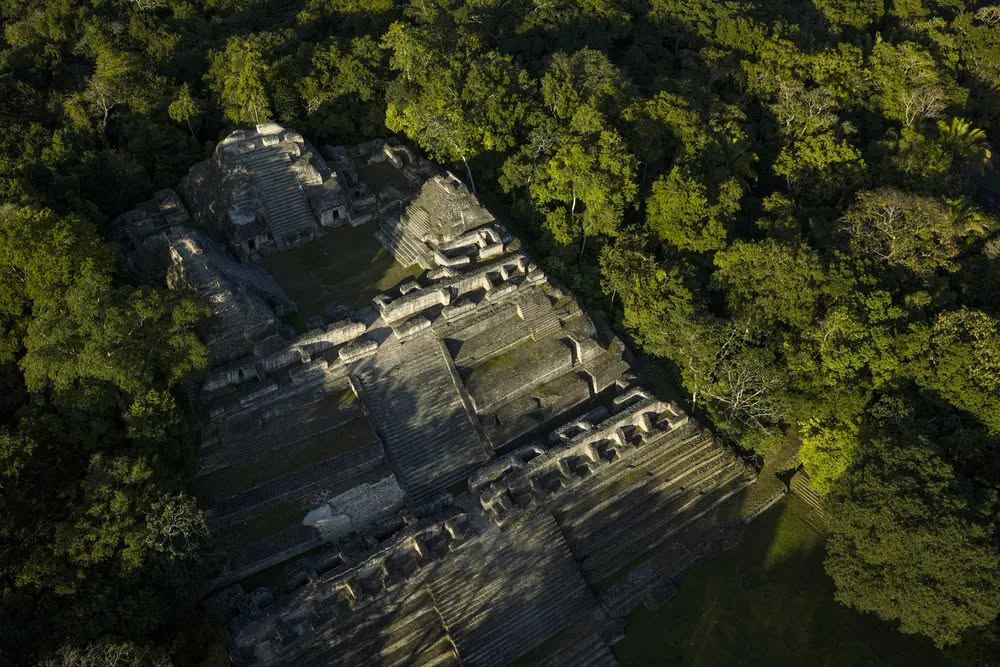
By Belize Live News Staff: Long before modern Belize existed, an enormous Maya city deep in the Chiquibul rainforest supported more than 100,000 people, complete with neighborhoods, marketplaces, roads and an advanced water management system.

That ancient city was Caracol, and new research highlighted by Smithsonian Magazine is challenging longstanding beliefs about how the Maya lived.
Archaeologists Arlen and Diane Chase have spent approximately four decades studying the site, uncovering evidence that Caracol was among the most sophisticated urban centers of the ancient Maya world.
Using advanced laser mapping technology known as lidar, researchers identified approximately 36,000 structures across a vast landscape covering 77 square miles.
The findings revealed an extensive network of roads connecting residential communities, marketplaces and ceremonial centers.
Unlike earlier assumptions that ordinary Maya residents lived far from major cities, researchers found that Caracol’s inhabitants occupied organized neighborhoods with access to trade and essential services.
The ancient city also featured approximately 1,600 reservoirs and extensive agricultural terraces that helped support its population.
Perhaps most remarkably, researchers discovered evidence that Caracol defeated Tikal, one of the most powerful Maya kingdoms, and became a dominant regional force.
In 2025, another significant discovery emerged when archaeologists uncovered a tomb believed to contain the remains of Te K’ab Chaak, an early ruler associated with Caracol’s founding dynasty.
The tomb contained jade ornaments, pottery and fragments of a ceremonial mask.
Today, Caracol remains one of Belize’s most important archaeological attractions, with its towering Caana temple rising 141 feet above the surrounding landscape.
The Smithsonian feature brings fresh international attention to Belize’s ancient Maya civilization and the discoveries that continue to reshape its history.