By Belize Live News Staff: Picture the assignment. A CNN travel writer rounds up the 24 strangest sights nature ever made, monster trees in England, snow creatures in Japan, a desert eye visible from space, a lake the colour of bubblegum. Now pick one photo to lead the whole parade.

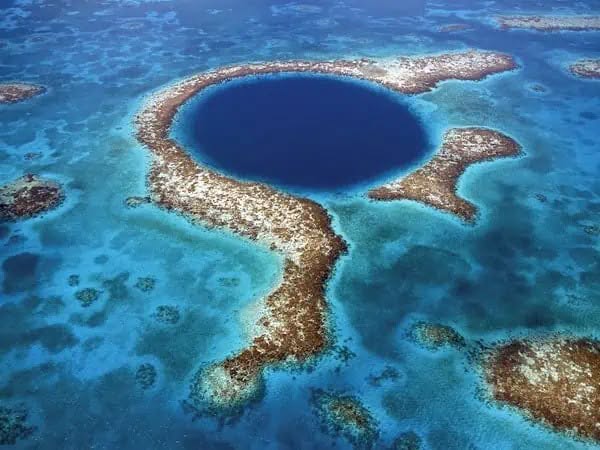
CNN picked ours. Belize’s Great Blue Hole sits at the top of the network’s newly updated feature on the world’s most unusual landscapes, the opening image for Earth’s entire catalogue of weird, and honestly, what else could compete?
Look at what it beat out. Ireland brought a causeway built by a legendary giant. Turkey brought fairy chimneys hiding underground cities. Hawaii brought a volcano that shoots lava 300 feet into the sky. The Philippines brought over a thousand chocolate-coloured hills. Beautiful efforts, all of them. But none of them is a perfect navy circle punched into turquoise sea, 300 meters across and 125 meters deep, the biggest sinkhole on the planet, sitting in our reef like the ocean’s own eye.
The feature tips its hat to Jacques Cousteau, the legendary explorer who put the Blue Hole on the world diving map, and drops the detail that keeps scientists coming back: recent submarine expeditions have built 3D sonar maps of the depths, revealing mineral formations no human eye had ever seen. Thousands of years after rising seas flooded its caves, the hole is still keeping secrets.
Here’s the fun question for the home crowd, though. The world flies across oceans to see our Blue Hole. Divers save for years. CNN crowns it the face of Earth’s wonders. So, Belize, hand on heart, have you seen it yourself? Flown over it, dived it, snorkelled the atoll around it? Or is the world’s most famous sinkhole the wonder in our own backyard we keep promising ourselves someday?
The planet has spoken through CNN, and it picked Belize for the cover. Someday might deserve a date.
Tell us in the comments: have you visited the Great Blue Hole, and was it everything they say?