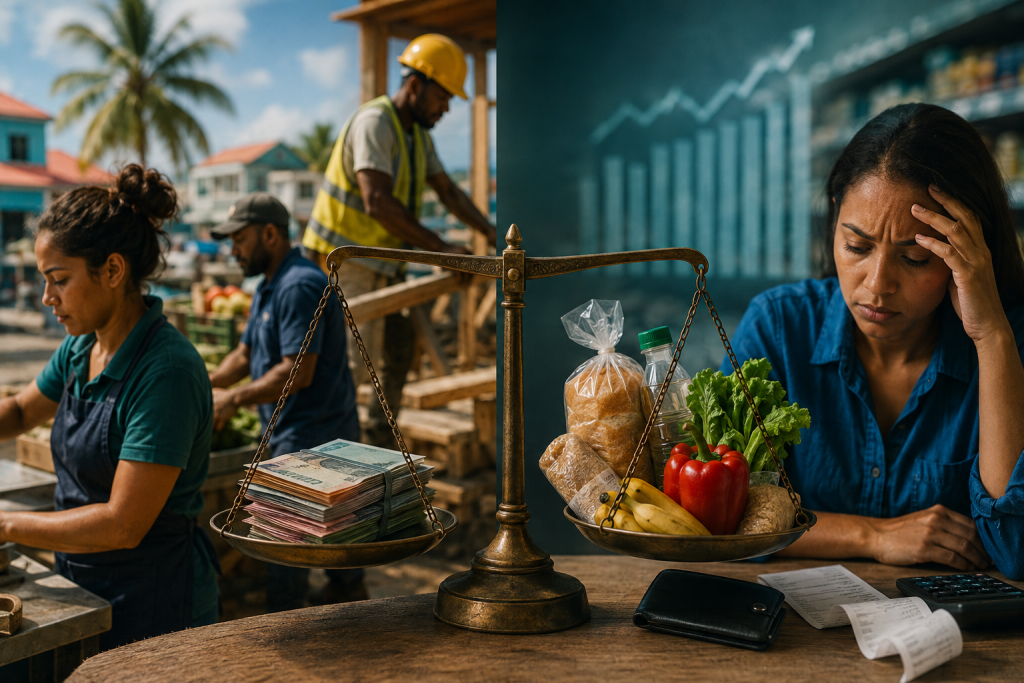
By Belize Live News Staff: Raising Belize’s minimum wage from $5 to $6 sounds like an obvious victory for workers. For someone working 40 hours a week, the headline calculation is an additional $40 per week before deductions, or roughly $2,080 over 52 weeks. That is real money, and workers struggling with today’s prices understandably want it. But the more important question is not how many dollars appear on a paycheck, but how much those dollars can actually buy.

That distinction is called purchasing power. If your salary rises by 20 percent but the cost of the things you buy also rises, part of your raise disappears in real terms. If businesses reduce hours, increase prices, automate jobs, or stop hiring, some workers can also lose part of the benefit. A higher wage therefore does not automatically translate into an equivalent increase in living standards.
Belizeans already understand this without needing an economics degree. The Statistical Institute of Belize reported that consumer prices in June 2026 were 4.6 percent higher than one year earlier. Earlier in May, food and non-alcoholic beverages, transport, and housing-related costs were all contributing to inflation. When groceries, electricity, transportation, rent, and other necessities become more expensive, workers feel it immediately.
That is why government must be careful not to confuse wages with wealth. A government can legally change the minimum wage with the stroke of a pen. It cannot legislate productivity, affordable housing, cheaper energy, or abundant goods into existence just as easily. Sustainable improvements in living standards ultimately depend on how much value an economy can produce.
Consider a small Belizean restaurant employing ten workers at the minimum wage for 40 hours each week. Moving from $5 to $6 adds $400 per week to its direct wage bill before considering any related payroll costs or wage adjustments for employees already earning slightly more. That is more than $20,000 per year in additional direct wages if staffing and hours remain unchanged. The restaurant has to find that money somewhere.
Perhaps the owner absorbs it through lower profits. Perhaps productivity improves enough to cover it. But the owner might instead raise menu prices, reduce employees’ hours, postpone hiring, or invest in technology that requires fewer workers. The response will differ from business to business.
Now multiply that calculation across restaurants, farms, shops, tourism businesses, security companies, construction firms, and other labour-intensive operations. Some businesses will absorb the increase relatively easily. Others, especially small businesses operating on thin margins, will have much less room. That is why the Prime Minister is right that businesses have to be considered too.
There is another effect that receives less attention: wage compression. Imagine a worker who has spent years developing skills and now earns $6.25 per hour while an entry-level employee earns $5. When the minimum moves to $6, the experienced employee may understandably demand an increase too. The actual impact on a company’s payroll can therefore extend beyond employees currently earning minimum wage.
The International Labour Organization calls these “spillover effects.” Workers earning above but close to the minimum can also experience wage increases after the wage floor rises. That can be good for those employees, but it also means businesses may face a broader increase in payroll than the headline $1 suggests. Companies then have to decide how those additional costs will be financed.
This does **not** mean minimum wage increases automatically cause mass unemployment. International evidence is considerably more complicated than that. The ILO notes that many studies find small or statistically insignificant overall employment effects, although outcomes vary considerably depending on the country, size of the increase, labour market, productivity, and businesses affected. Belizeans deserve that nuance rather than slogans from either side.
The Caribbean evidence is especially relevant. A 2025 ILO study covering employers across Caribbean territories found businesses responding to higher labour costs through combinations of price adjustments, efficiency improvements, and technology adoption. It did not find evidence of widespread employment losses or major price shocks across the region. But it emphasized that wage decisions should consider inflation, productivity, competitiveness, and employers’ ability to absorb increases.
That should be Belize’s approach.
Suppose a worker receives another $40 per week but subsequently loses five working hours because the employer cuts the schedule. At $6 per hour, 35 hours produces $210, compared with $200 for 40 hours at $5. The worker’s hourly wage jumped 20 percent, but weekly gross income increased only $10. The number on the wage order looks much better than the change inside that person’s pocket.
Or suppose the worker keeps all 40 hours and earns $240. That worker is clearly better off initially. But if food, transportation, electricity, rent, and other costs continue climbing, the real benefit gradually gets eaten away. This is why Belize should focus on **real wages**, not merely nominal wages.
There is also Belize’s informal economy to consider. A wage law only helps when workers are covered and employers comply with it. If higher labour costs push some activity toward informal arrangements, workers can lose legal protections altogether. Enforcement therefore matters just as much as the number government announces.
The strongest argument for $6 is also legitimate. Lower-income workers tend to spend much of additional income locally, meaning higher wages can generate more consumer demand. Businesses can benefit from customers having additional disposable income, employee turnover may decline, and better-paid workers can sometimes become more productive. A carefully calibrated minimum wage can therefore improve incomes without producing the disaster its strongest opponents predict.
But none of that makes $6 a substitute for economic reform.
If government genuinely wants Belizeans to become wealthier, it has to attack the cost side of the equation too. Belize needs cheaper and more reliable energy, greater agricultural productivity, more housing supply, better transportation, stronger competition, easier access to business financing, and policies that allow companies to invest in productivity. Making Belize cheaper and more productive can increase purchasing power without simply moving costs from one pocket to another.
Belize should also make productivity central to the wage conversation. If a worker produces $50 of value per hour instead of $20, businesses have far greater room to pay that worker more. Technology, training, better equipment, education, infrastructure, and efficient government can all raise productivity. That is how countries sustainably move from low wages toward high wages.
We should want Belizeans earning far more than $6 per hour. The national ambition should not be creating an economy where everybody survives on a government-mandated wage floor. It should be creating an economy where employers compete for productive workers and naturally offer $8, $10, $15, or $20 an hour because the workers generate enough value to justify it. That is a fundamentally different economic model.
A $6 minimum wage can help some workers, and pretending otherwise would be dishonest. But $6 by itself cannot solve Belize’s cost-of-living problem. If prices rise, hours fall, informality increases, or businesses cannot become more productive, part of the promised benefit can disappear. A bigger paycheck means surprisingly little if everything around you keeps becoming more expensive.
Belizeans should therefore ask a better question than whether the minimum wage should be $5 or $6. We should ask how Belize can make every hour of Belizean labour more valuable while simultaneously making essential goods and services more affordable. Solve that problem and workers will not merely have more dollars in their pockets. **Those dollars will actually buy more.**